
Building a website or application used to follow a fairly predictable formula: write a specification, design wireframes, hire developers, configure hosting, connect a database, test everything, fix bugs, and eventually launch. That process still has its place, especially for highly complex products, but AI website and app builders are dramatically changing how software gets created in 2026. Instead of starting with a blank code editor, you can now describe what you want in ordinary language and watch an AI system generate interfaces, application logic, databases, authentication systems, integrations, and even deployment workflows. The result is a much shorter distance between an idea and something people can actually use.
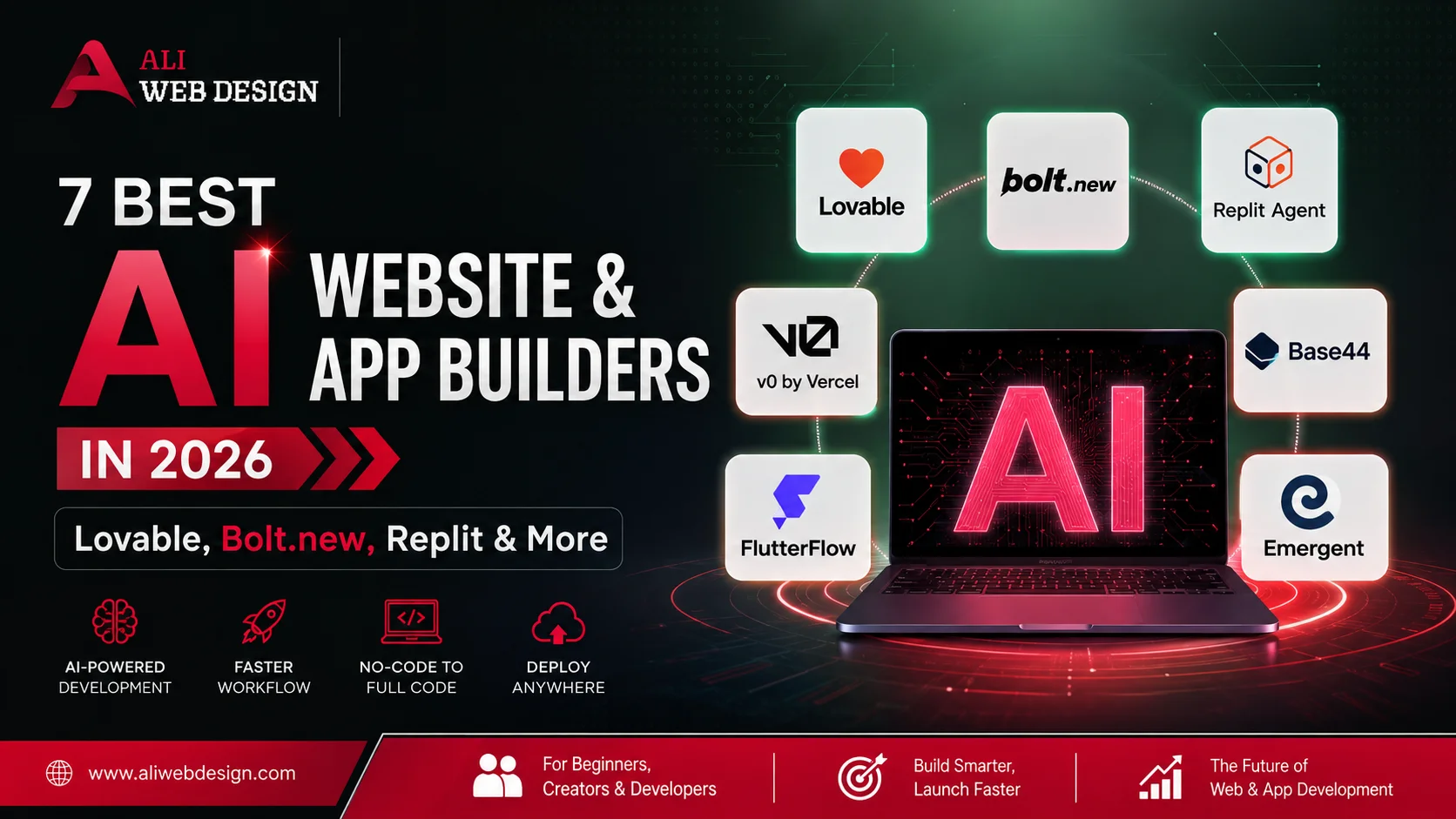
The interesting part is that these platforms are not all solving exactly the same problem. Some are designed around conversational full-stack development, while others focus heavily on visual design, mobile applications, React interfaces, or complete business applications. That distinction matters. A freelancer building a marketing website has very different requirements from a startup founder building a SaaS platform, and a mobile app developer may care far more about native deployment than someone creating a web-based CRM. In this guide, we are focusing on seven AI website and app builders worth watching in 2026: Lovable, Bolt.new, Replit Agent, v0 by Vercel, Base44, FlutterFlow, and Emergent.
What Are AI Website and App Builders?
AI website and app builders are platforms that use generative AI to transform natural-language instructions into software. Instead of manually writing every component, you can tell the platform something like, “Create a modern booking website with customer registration, appointment availability, online payments, an admin dashboard, and email notifications.” The AI then interprets the request and generates some or all of the required interface and functionality. The exact capabilities vary considerably between platforms, but the common idea is simple: you describe the product rather than manually constructing every technical layer from scratch.
That makes AI builders particularly interesting for entrepreneurs, designers, marketers, agencies, developers, and small businesses. A founder can validate an idea before spending heavily on a development team. A designer can turn a concept into an interactive prototype. An agency can accelerate repetitive development work. A developer can use AI to handle boilerplate while concentrating on architecture and business logic. Lovable describes its platform as a full-stack AI development environment capable of generating frontend, backend, database, authentication, and integrations from natural-language instructions, while Base44 similarly focuses on turning prompts into functional applications with screens, data, backend logic, authentication, permissions, integrations, and deployment.
How AI Builders Have Changed Web Development
The biggest change is not simply that AI can write code. Developers have had access to AI coding assistants for years. The more significant development is that modern AI builders are beginning to connect planning, generation, testing, infrastructure, and deployment into one workflow. Replit Agent, for example, positions itself as an agent that can build and refine applications through conversation, while Replit provides infrastructure services such as authentication, databases, hosting, and monitoring inside its platform.
Think of traditional development as assembling a car from individual parts. You need to understand the engine, transmission, electrical system, body, and controls, and you need to connect everything yourself. An AI builder is closer to having an intelligent workshop where you explain the kind of car you want and the system prepares a large portion of the assembly. You still need to inspect the result, make decisions, test it, and sometimes bring in a skilled engineer, but the starting point is dramatically different. That is why the conversation around AI development in 2026 has moved beyond “Can AI generate a webpage?” toward a more practical question: How much of a real product can AI help you build, launch, and maintain?
What to Look for in an AI Builder
Choosing an AI builder simply because its homepage looks impressive can be a mistake. The right platform depends on what you are actually trying to produce, how much control you need, whether you understand code, and what happens after the first prototype works. A visually beautiful landing page may require very little backend functionality, while a CRM needs authentication, roles, permissions, database relationships, search, filtering, dashboards, and reliable data handling. A mobile application introduces another layer of requirements around device behavior, app-store distribution, notifications, performance, and native capabilities.
There are also questions around code ownership, integrations, databases, deployment, customization, scalability, and vendor dependence. Some platforms are optimized for speed and simplicity, while others give experienced developers much deeper access to the underlying code. Some work primarily with web technologies, while FlutterFlow is designed around cross-platform application development and can export code. The best choice is therefore not necessarily the platform with the most AI features. It is the platform that creates the shortest path between your idea and the final product you actually need.
Website, Web App, or Native Mobile App?
Before choosing a platform, define the word app. A responsive website, SaaS web application, progressive web app, and native iOS or Android application are not interchangeable. Lovable, for example, is focused on web applications rather than native mobile applications, although its web apps can be designed to work well on mobile screens. Bolt can build websites and web applications and also supports mobile development workflows through technologies such as Expo. FlutterFlow, meanwhile, is specifically positioned as a visual development platform for mobile, web, and desktop applications, with deployment options covering app stores and the web.
This difference can completely change your decision. If you need a marketing website, you may prioritize design, SEO, speed, and content management. If you need a SaaS platform, database and authentication capabilities become much more important. If your goal is an iPhone and Android application, native or cross-platform deployment becomes a central requirement. A useful rule is to decide the destination first and the builder second. Once you know where the finished product needs to live, the list of sensible tools becomes much smaller.
1. Lovable
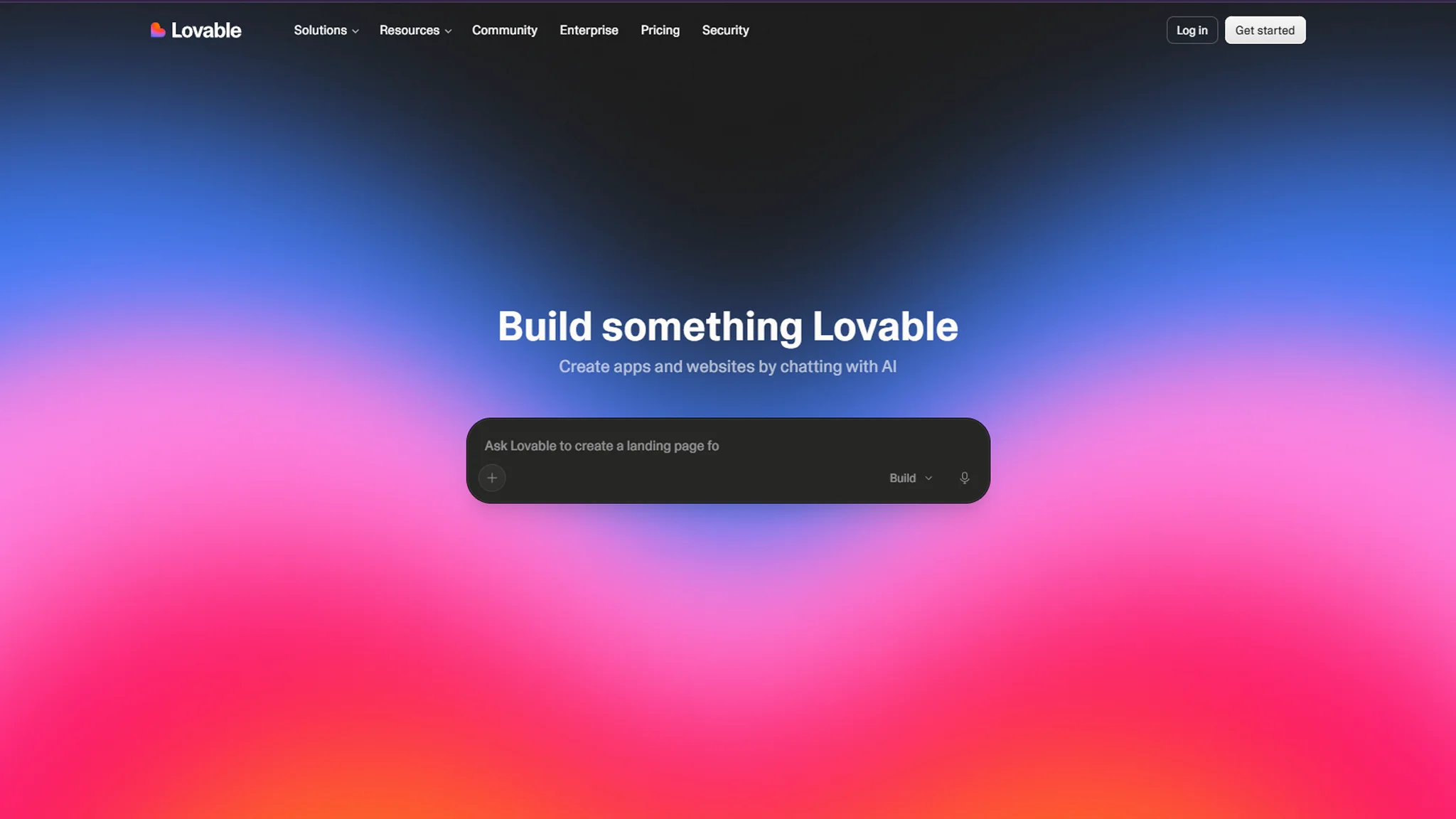
Lovable has become one of the most recognizable names in the AI app-building space because it makes software creation feel remarkably conversational. You describe an application or website, and the platform generates a working result that you can continue refining through additional prompts. Its documentation states that Lovable generates frontend, backend, database, authentication, and integrations, while its current platform supports modern web development workflows and editable code.
The real attraction is the feedback loop. Instead of writing a large technical specification and waiting for someone to implement it, you can start with a rough idea and gradually shape the product. You might first request a dashboard, then ask for authentication, then add a customer-management module, then adjust the design, then improve the mobile layout. This makes Lovable especially appealing for founders and agencies that want to move from concept to usable prototype quickly. It is also useful when the person with the strongest understanding of the product is not necessarily the person who wants to spend their day writing code.
Why Lovable Stands Out
Lovable’s biggest strength is arguably its end-to-end web application workflow. The platform is designed around generating functional applications rather than simply producing static visual mockups. Its current documentation also notes that new projects created from May 13, 2026 use TanStack Start with server-side rendering, while older projects use React and Vite.
That technical evolution is important because AI builders are increasingly moving toward production-oriented applications rather than disposable demonstrations. Lovable also supports integrations and backend functionality through Lovable Cloud, Supabase, and third-party APIs. For a business owner who wants a customer portal, internal dashboard, booking system, CRM, or SaaS prototype, that combination can be extremely attractive. The main limitation is equally important: Lovable is primarily a web application platform, not a dedicated native mobile app builder.
Best Use Cases for Lovable
Lovable makes the most sense when you want to turn a detailed product idea into a functional web application without building every layer manually. SaaS prototypes, internal business tools, client portals, dashboards, booking systems, marketplaces, and AI-powered web applications are natural candidates. It is also useful for designers who want to go beyond static Figma concepts and immediately test real interactions.
For professional developers, Lovable can be viewed less as a replacement for engineering and more as a high-speed development partner. The generated code remains part of the workflow, which means technical users can inspect and modify what has been created rather than treating the platform as a completely opaque black box. For non-technical users, the value is simpler: they can explain what they want and iterate visually and conversationally. That flexibility is what makes Lovable one of the strongest choices for people who want the experience of “prompting a product into existence.”
2. Bolt.new
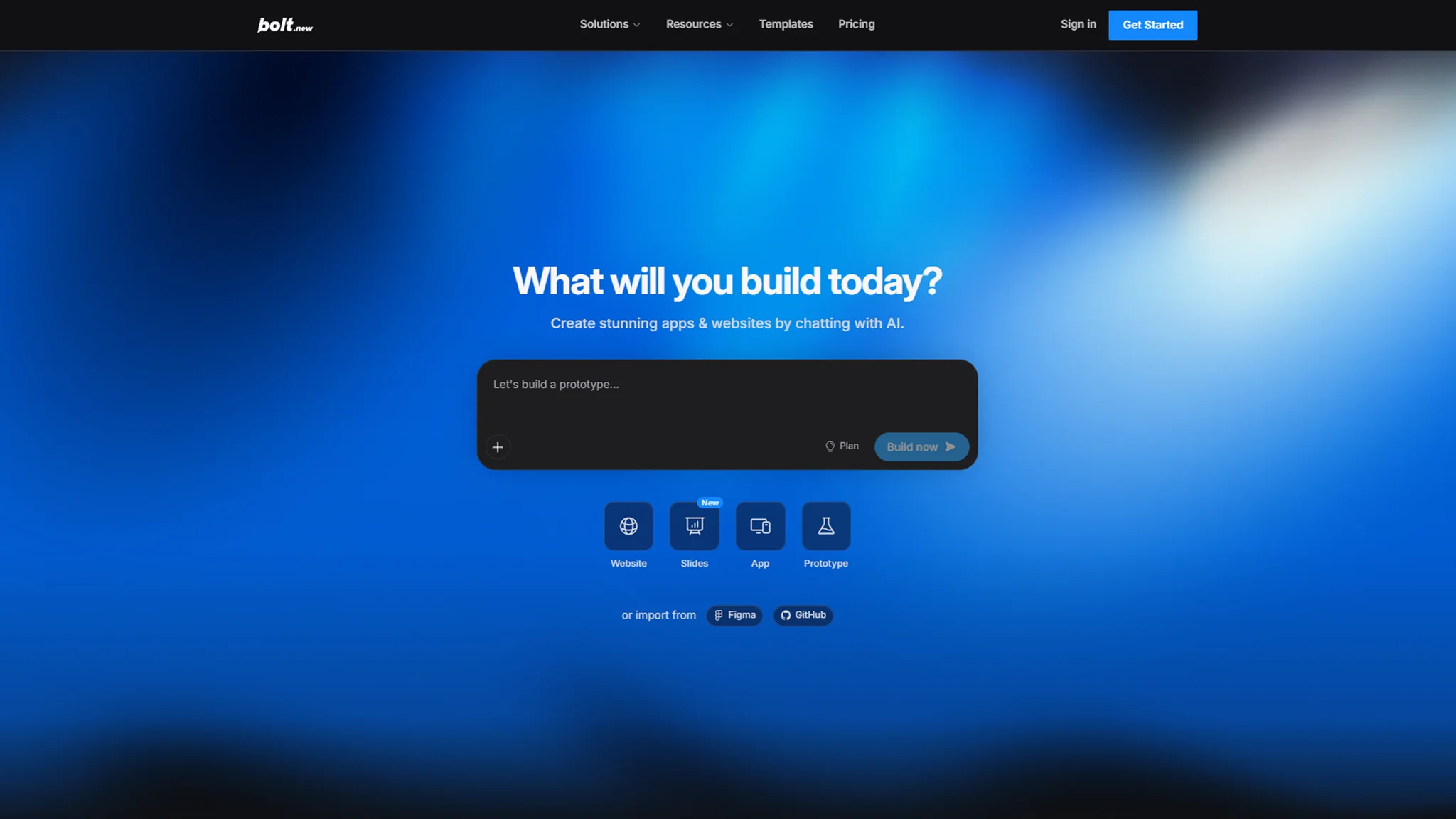
Bolt.new takes a similarly conversational approach but places strong emphasis on the browser-based development experience. Its official documentation describes Bolt as an AI-powered builder for websites, web applications, and mobile apps, allowing users to describe an idea in chat and then refine the resulting project. Bolt also provides a browser-based code editor, preview environment, backend capabilities, and deployment tools, which makes it particularly appealing to users who want to move quickly without leaving the browser.
One of Bolt’s most compelling characteristics is speed. Its official AI app builder page currently claims that users can create ready-to-publish applications in under two minutes for many use cases, although actual development time naturally depends on the complexity of the project. Bolt’s website builder similarly emphasizes responsive layouts, code editing, backend support, and one-click deployment. This makes it a strong option when the priority is going from a blank idea to a working, shareable product extremely quickly.
The platform also fits a useful middle ground. Beginners can work almost entirely through prompts, while developers can open the generated code and make direct changes. Bolt’s documentation highlights integrations such as GitHub, Figma, Expo, and Stripe, giving it a practical ecosystem for projects that need more than a simple landing page. For freelancers and agencies, that flexibility is valuable because one project may require visual iteration while another may require direct code control.
3. Replit Agent
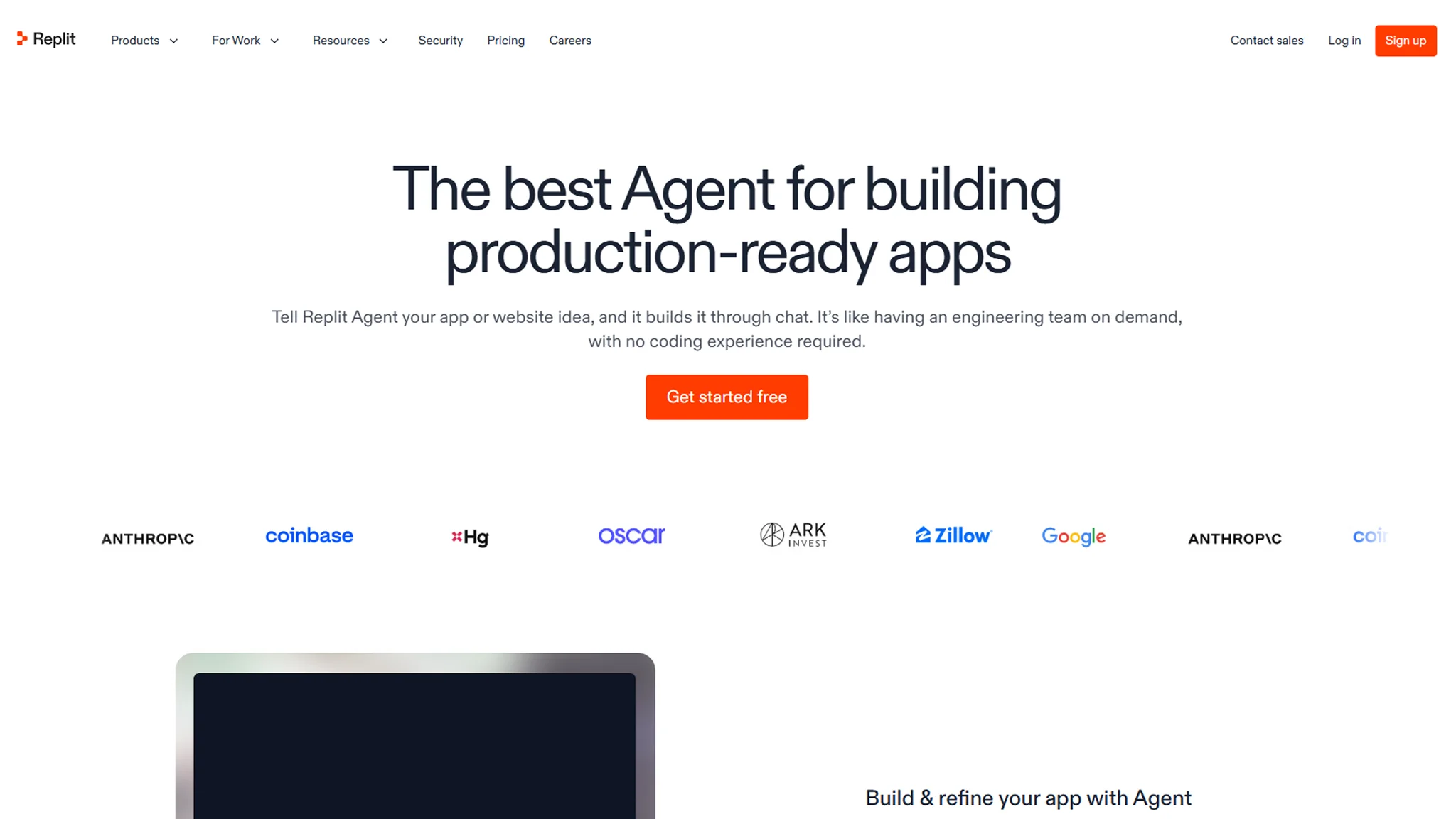
Replit Agent approaches AI development from the perspective of an AI software-building agent inside a development platform. Instead of simply generating a page from a prompt, Agent is designed to interpret a broader project request, build the application, refine it based on feedback, and help deploy it. Replit currently describes Agent as capable of building applications and websites automatically through chat, without requiring the user to write code manually.
What makes Replit particularly interesting in 2026 is the breadth of its development environment. Replit’s current platform highlights websites, mobile applications, games, dashboards, visual experiences, documents, data visualizations, and other project types. It also describes Agent 4 features such as parallel agents, an infinite canvas for design exploration, multiple artifacts, and built-in infrastructure. That gives Replit a broader “build a project” feel rather than a narrowly focused website generator.
For developers, Replit can be particularly appealing because the platform retains a recognizable development environment beneath the AI layer. For beginners, the advantage is that many infrastructure decisions are handled inside the platform. Replit states that its built-in services include authentication, database, hosting, and monitoring, allowing applications to move from idea toward deployment without assembling every service independently. If you want an AI assistant that behaves more like a software-development teammate than a simple website generator, Replit Agent deserves serious attention.
4. v0 by Vercel
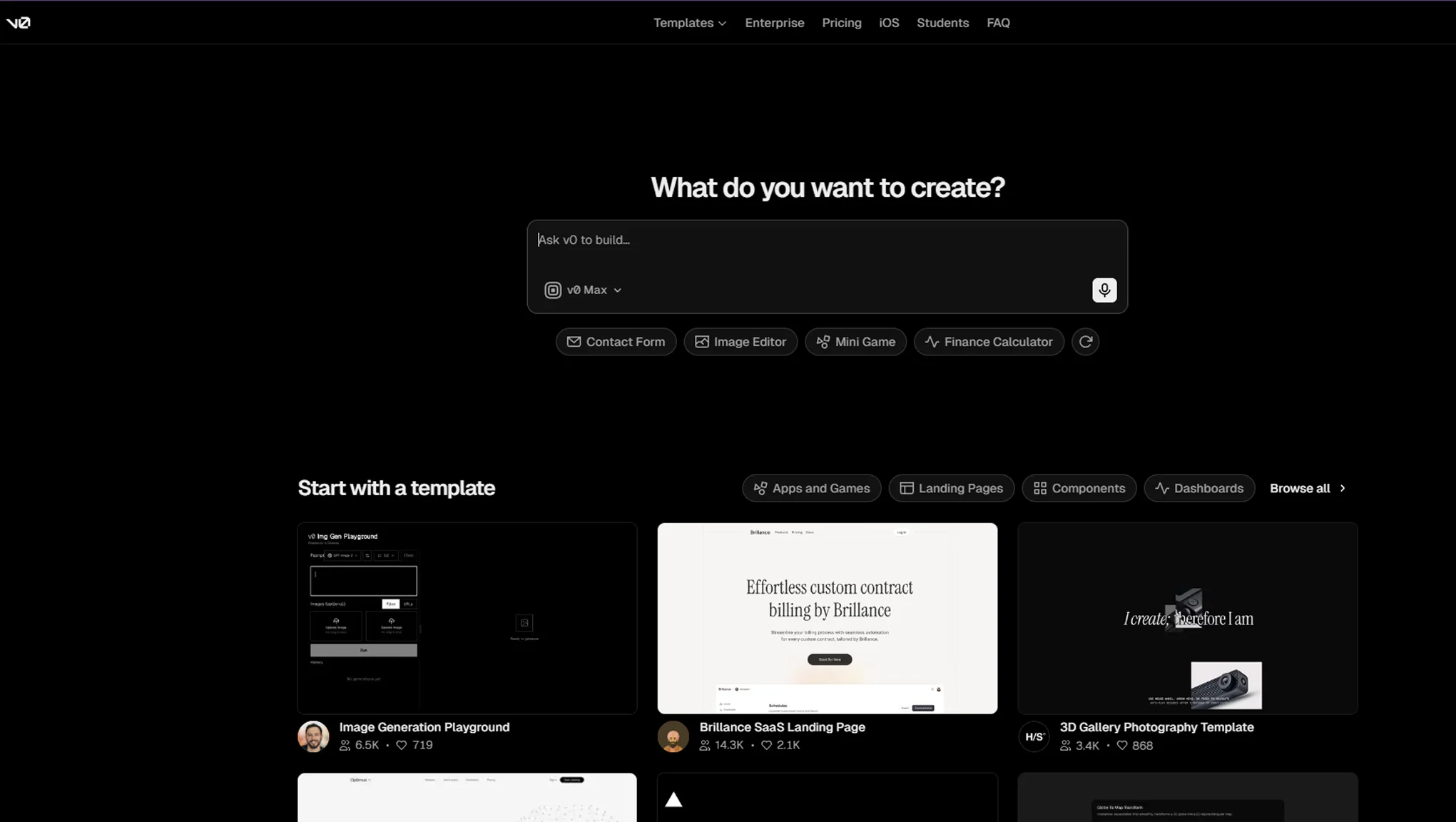
v0 by Vercel occupies a slightly different position in this group. It is strongly associated with AI-assisted interface and application development, particularly within the modern React and Next.js ecosystem. Its current interface describes the workflow very simply: prompt, build, publish, with the ability to generate working applications and publish live websites quickly. v0 also supports connecting projects with GitHub and integrating with other applications and APIs.
The biggest reason developers pay attention to v0 is the quality and speed of generating modern interfaces. If you are building a SaaS dashboard, marketing website, admin panel, product page, or application interface and want a polished contemporary frontend quickly, v0 can dramatically shorten the design-to-code cycle. It is particularly attractive to teams already working in the Vercel ecosystem because the workflow naturally fits modern web development practices.
The important distinction is that v0 should not necessarily be treated as identical to an all-in-one no-code platform. Depending on the project, you may still need to make decisions about backend architecture, authentication, database services, APIs, and other infrastructure. That can actually be an advantage for experienced developers because it provides more flexibility rather than forcing every technical decision into a single platform. For a developer who wants AI-assisted frontend generation while retaining control over the broader stack, v0 is one of the most compelling choices in 2026.
5. Base44
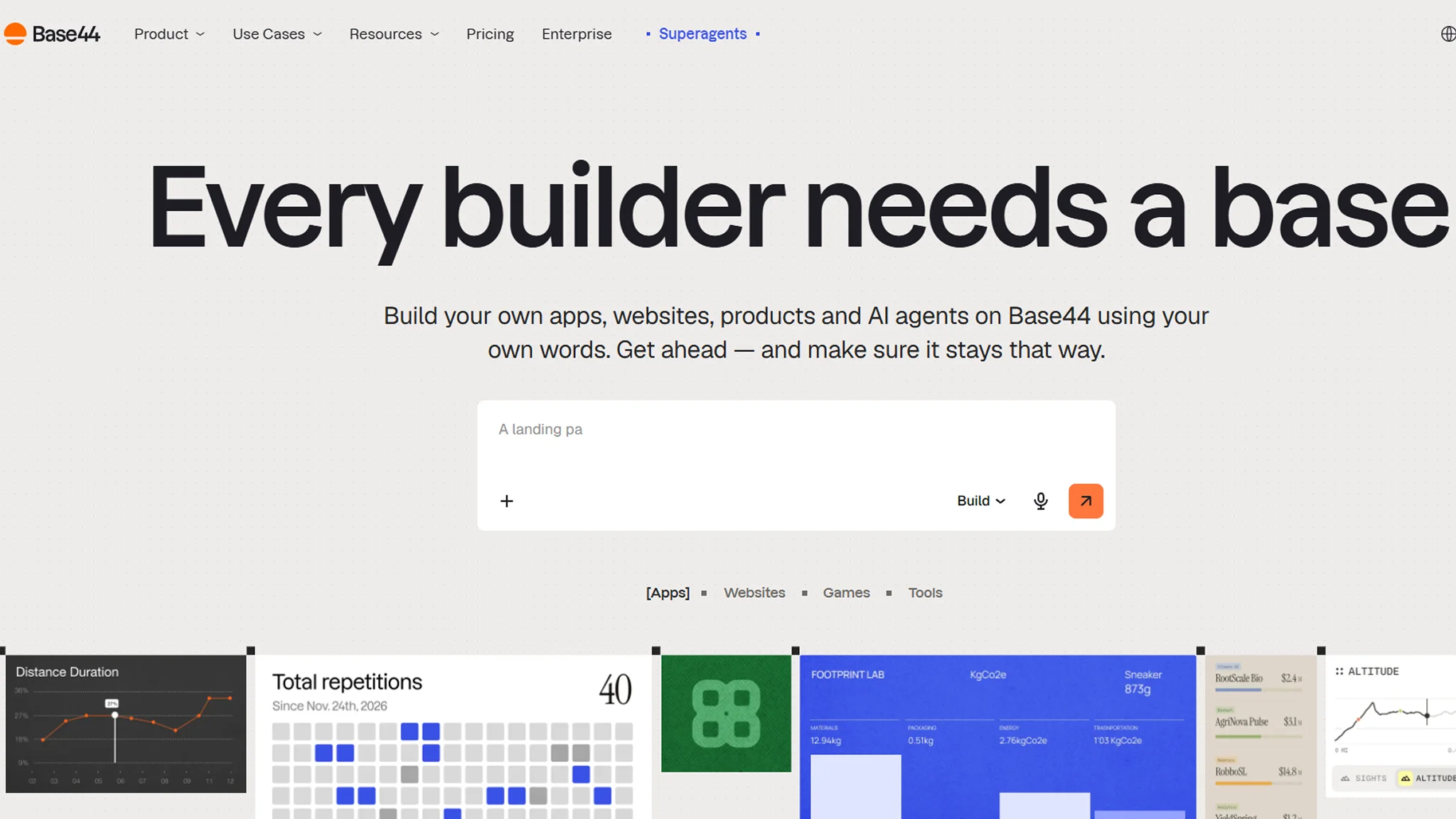
Base44 is built around the idea that an AI app builder should produce a functional business application rather than merely a prototype. Its official platform says users can create applications with screens, data, backend logic, authentication, permissions, integrations, and deployment from one platform. That positioning makes it particularly interesting for people who have a business workflow in mind but do not necessarily want to assemble a traditional development stack themselves.
Imagine a company needing an internal inventory system. Instead of asking an AI to design an inventory dashboard and then separately configuring the database, authentication, permissions, and workflows, you can describe the complete business requirement. Base44 is designed to handle those layers together. The platform also provides built-in hosting, and its current website advertises a free starting tier with paid plans available as projects become more demanding.
Why Base44 Is Worth Considering
Base44’s appeal comes from its focus on business functionality and speed. It can generate dashboards, forms, portals, administrative systems, and other applications where data and workflows matter just as much as visual design. The platform describes its process as moving from a natural-language description to a working application, followed by iterative refinement.
This makes Base44 worth considering for small businesses, operations teams, entrepreneurs, and agencies building practical internal tools. If your idea sounds more like “I need an employee portal with login, records, permissions, and reporting” than “I need a beautiful landing page,” a business-focused AI builder may be a better fit. Base44 is therefore one of the platforms to watch if the AI app-builder market continues shifting from prototypes toward complete operational software.
6. FlutterFlow
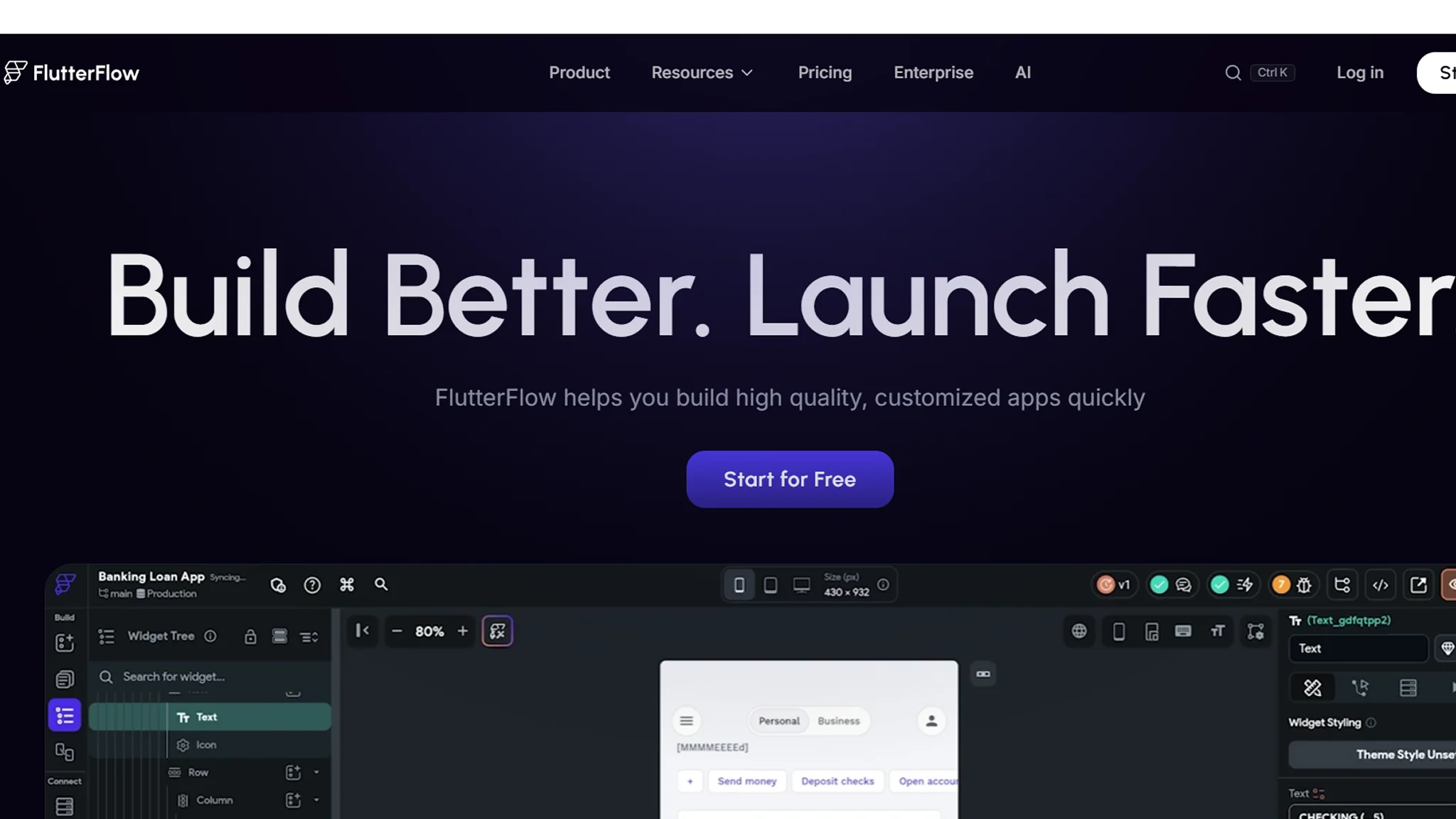
FlutterFlow is different from most of the other platforms on this list because it combines visual application development with AI assistance. Rather than relying exclusively on a conversational prompt-to-app workflow, FlutterFlow gives developers and product teams a visual environment where they can design interfaces, build logic, connect databases, configure APIs, and customize application behavior. Its current platform supports mobile, web, and desktop applications, with integrations including Firebase, Supabase, and REST APIs.
FlutterFlow is especially interesting for mobile development. Its platform supports deployment to the App Store, Google Play, and the web, and it emphasizes code ownership through code export. That is a major difference when compared with tools primarily focused on web applications. If you are building a serious cross-platform mobile product and want visual development without giving up the possibility of working with generated Flutter code, FlutterFlow deserves a place near the top of your shortlist.
Its AI capabilities are also expanding. FlutterFlow’s AI tools can generate and update components and pages, while its AI Agent functionality can bring conversational AI, image generation, text-to-speech, speech-to-text, and video generation into applications. This combination makes FlutterFlow particularly attractive for teams that want both visual control and AI-assisted development rather than a purely prompt-driven experience.
7. Emergent
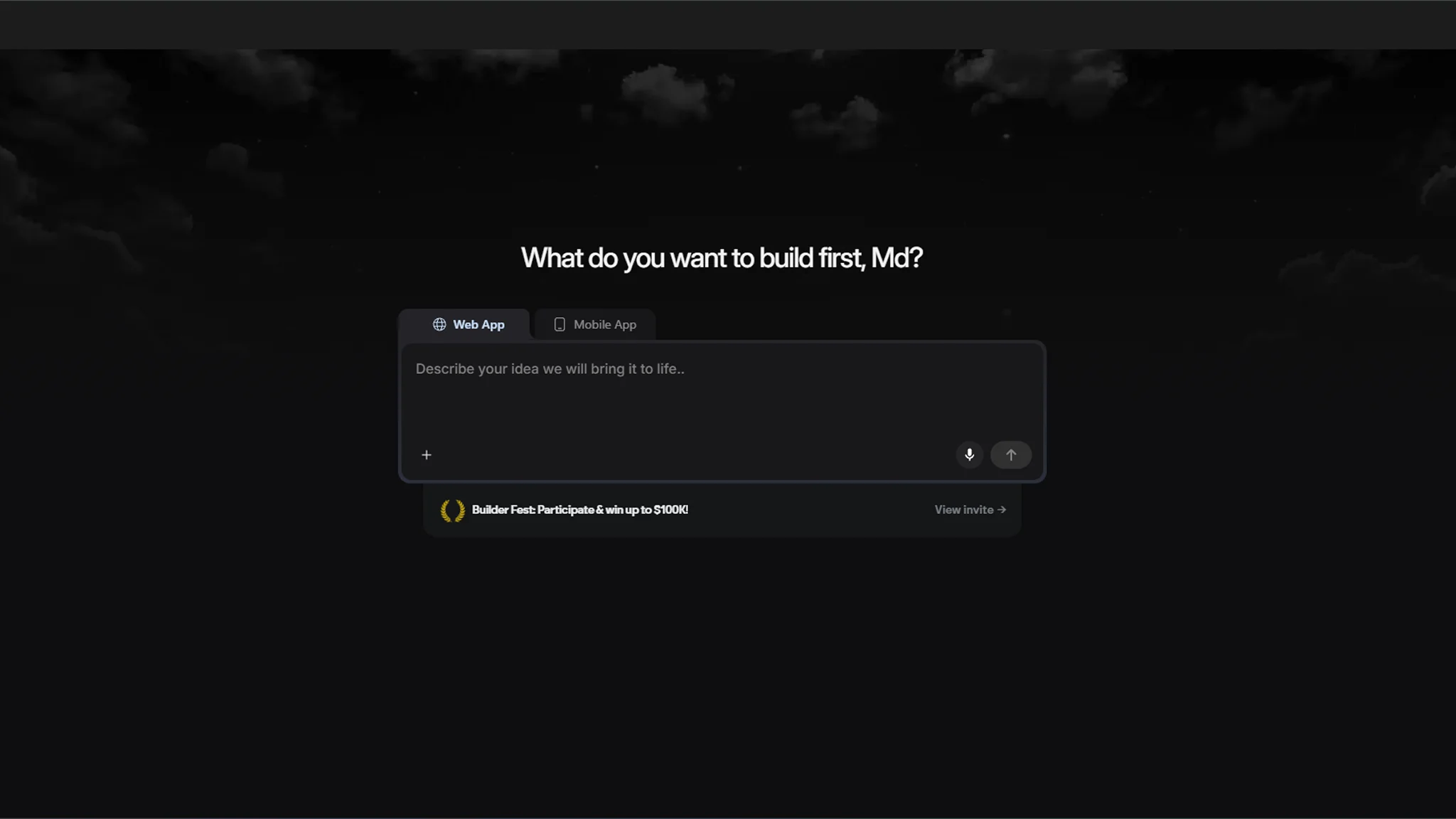
Emergent is one of the more interesting newer names in this category because it places strong emphasis on agentic AI app development. Its current platform describes a workflow in which AI agents design, code, and deploy applications from start to finish. The platform supports websites, mobile applications, dashboards, SaaS tools, and other business-focused software.
Its mobile capabilities are particularly notable. Emergent currently advertises the ability to create native Android and iOS applications as well as progressive web applications, with export-ready builds intended for app-store publishing. That makes it relevant for users who want to move beyond responsive websites and into mobile products without starting with a traditional development environment.
The platform also emphasizes building complete interfaces and workflows from prompts. You can describe screens, user flows, forms, tables, charts, and application behavior, then refine the result conversationally. For entrepreneurs and agencies, this can be powerful because the same basic idea can potentially be explored as a website, dashboard, or mobile application. Emergent is therefore particularly worth watching as AI builders increasingly compete on how much of the product lifecycle their agents can handle.
AI Website & App Builder Comparison
The seven platforms overlap, but they should not be treated as interchangeable. Lovable is particularly strong for conversational full-stack web application development. Bolt.new emphasizes rapid browser-based building and deployment. Replit Agent brings a broader development environment and agentic workflow. v0 is particularly attractive for modern web interfaces and developers working around the Vercel ecosystem. Base44 focuses strongly on functional business applications, while FlutterFlow is a major contender for visual cross-platform app development. Emergent is pushing aggressively toward agentic creation of web and mobile products.
| Platform | Best For | Website | Web App | Mobile App | Visual Builder | AI Prompting |
|---|---|---|---|---|---|---|
| Lovable | Full-stack web apps | Yes | Yes | Web-focused | Limited | Excellent |
| Bolt.new | Fast websites and web apps | Yes | Yes | Supported workflows | Moderate | Excellent |
| Replit Agent | AI-assisted software development | Yes | Yes | Yes | Growing | Excellent |
| v0 by Vercel | Modern web UI and applications | Yes | Yes | Not its main focus | Moderate | Excellent |
| Base44 | Business applications | Yes | Yes | Platform-dependent | Moderate | Excellent |
| FlutterFlow | Cross-platform mobile apps | Yes | Yes | Yes | Excellent | Strong |
| Emergent | Agent-built web and mobile apps | Yes | Yes | Yes | AI-driven | Excellent |
This comparison is not about declaring one universal winner. The current market itself shows that different builders are optimized around different workflows. Recent industry comparisons similarly distinguish between platforms based on areas such as production readiness, code ownership, databases, authentication, payments, and deployment rather than treating every AI builder as identical.
Which AI Builder Is Best for Beginners?
For beginners, the best platform is usually the one that minimizes the number of technical decisions required before seeing something useful. That makes conversational platforms such as Lovable, Bolt.new, Base44, Replit Agent, and Emergent particularly attractive. Instead of learning a framework before starting, a beginner can describe the desired outcome and let the platform establish an initial structure. The user can then respond to what appears on screen and improve it step by step.
That does not mean beginners should expect perfect applications from one prompt. AI-generated software still needs testing, especially when money, user accounts, sensitive data, or business-critical workflows are involved. A generated checkout page may look perfect while containing a subtle configuration problem. A dashboard may display attractive numbers without correctly handling edge cases. The smartest beginner workflow is therefore prompt, inspect, test, refine, repeat rather than “prompt once and launch.”
Base44 can be particularly approachable for business users because its interface is built around turning requirements into functional applications with backend logic, authentication, and data. Bolt and Lovable are also compelling when the goal is a polished web product. The best beginner platform is ultimately the one whose generated output is closest to what the beginner already understands.
Which AI Builder Is Best for Professional Developers?
Professional developers generally care about a different set of priorities. They want speed, but they also want code access, architecture control, version control, integrations, debugging capabilities, and the ability to take the project outside the AI platform when necessary. That makes Replit Agent, Bolt.new, Lovable, and v0 particularly interesting depending on the developer’s preferred stack and workflow.
Replit has an especially strong argument because Agent operates within a broader development environment and Replit provides infrastructure services alongside the AI workflow. Bolt is attractive for developers who want a browser-based environment where generated code can be edited directly. Lovable is appealing for developers who want rapid full-stack generation while retaining editable code and integrations. v0 is especially compelling when the frontend is the bottleneck and the developer wants AI to accelerate interface construction.
The key is not to ask, “Which AI builder replaces developers?” A better question is, “Which AI builder removes the most repetitive work from my development process?” That framing leads to much more realistic expectations. A skilled developer can use these platforms to prototype, generate boilerplate, explore UI concepts, build internal tools, and accelerate implementation while still taking responsibility for architecture and quality.
Which Builder Is Best for Mobile Apps?
If mobile is your primary objective, the shortlist changes considerably. FlutterFlow is one of the clearest choices because mobile development is central to the platform’s identity. FlutterFlow supports mobile, web, and desktop development, integrates with services such as Firebase and Supabase, and provides code export. Emergent is also particularly interesting because it currently promotes native Android and iOS application creation through natural-language prompts.
Replit and Bolt can also participate in mobile workflows, but the specific architecture and deployment approach matter. Bolt’s documentation, for example, identifies Expo as part of its supported integration ecosystem. Replit currently presents mobile apps as one of the project types available through its broader AI development environment.
If your project is primarily a native mobile product, start by evaluating FlutterFlow and Emergent. If mobile is secondary to a web application, Lovable, Bolt, Replit, or Base44 may make more sense. The distinction is important because “mobile responsive” and “mobile application” are two completely different development targets.
Which Builder Is Best for Business Websites?
For ordinary business websites, the answer depends heavily on how much functionality you need. A five-page company website with a homepage, services, about page, contact form, testimonials, and blog does not need the same technology as a SaaS platform. Bolt’s AI website builder is designed specifically around creating responsive websites from natural-language descriptions and includes direct browser editing and deployment capabilities. Lovable can also create websites and web applications through conversational prompting.
Emergent is another strong option for users who want an AI-generated professional website and want to keep expanding it into something more functional. Its website builder focuses on generating complete pages, layouts, components, forms, tables, filters, and other interface elements from prompts.
For an agency, however, the decision may be less about which tool can create a website and more about which tool fits the agency’s delivery process. You need to consider revisions, client handover, hosting, code ownership, integrations, maintenance, and the ability to reproduce the same workflow across many projects. AI can make the first version extremely fast, but agencies should build their processes around repeatability rather than chasing whichever tool happens to produce the flashiest demo.
How Much Can You Really Build With AI?
The honest answer in 2026 is: a lot, but not everything without supervision. Current platforms can create landing pages, dashboards, booking systems, CRMs, customer portals, e-commerce interfaces, SaaS prototypes, internal business tools, mobile applications, and other software categories. Base44 explicitly positions itself around functional applications with backend logic, authentication, permissions, integrations, and deployment. Replit similarly showcases business software, online shops, blogs, AI tools, games, mobile apps, and other categories.
The difficult part begins when the product becomes truly complex. Large systems involve security architecture, performance optimization, regulatory requirements, sophisticated integrations, complex data models, observability, disaster recovery, automated testing, accessibility, and long-term maintainability. AI can assist with many of these tasks, but generating code is not the same as proving that the resulting system is reliable.
The best way to think about AI builders is as force multipliers. A person with no technical experience may be able to create something that would previously have required a developer. A designer can turn visual ideas into functioning interfaces. A developer can move through repetitive implementation faster. An agency can prototype multiple approaches before committing to one. The technology is powerful precisely because it changes who can participate in software creation, but professional quality still requires human judgment.
The Future of AI Website and App Development
The direction of the market is becoming increasingly clear. AI builders are moving away from simple “generate a landing page” experiences toward agentic software development, where an AI system can interpret a broader objective, make implementation decisions, use tools, identify problems, and continue working through multiple stages. Replit’s current Agent workflow and Emergent’s agent-based approach are good examples of this broader direction.
At the same time, visual development is not disappearing. FlutterFlow demonstrates why. Many product teams still want precise control over layouts, actions, integrations, data, and responsive behavior, even when AI helps accelerate the process. The future may therefore not be “AI replaces visual builders” or “AI replaces developers.” It may be a combination in which AI handles increasingly large portions of implementation while humans retain control over product decisions and quality.
The biggest shift could be psychological. People are becoming less likely to ask, “Can I code this?” and more likely to ask, “Can I explain this clearly enough for AI to build it?” That is a profound change. Product thinking, clear requirements, UX judgment, testing, and business understanding become more valuable because the mechanical act of writing code is no longer the only gateway to building software.
How to Choose the Right AI Builder
Start with the product, not the tool. Write down exactly what you need to build, who will use it, where it will run, what data it will store, what integrations it requires, and how it will be maintained after launch. Then decide whether you need a website, web application, progressive web app, or native mobile application. This simple exercise will eliminate many unsuitable platforms before you even begin testing them.
Next, build the same small feature in two or three platforms. Do not compare marketing pages. Give each platform a realistic prompt such as a customer portal with authentication, a dashboard, data records, responsive design, and one external API. See how quickly each platform gets you from prompt to working result, then inspect the generated application. Look at the quality of the interface, the reliability of the functionality, the ease of making changes, the deployment workflow, and how much control you have when the AI makes a mistake.
Finally, think beyond the first launch. Ask what happens if you need a developer six months from now. Can you export or access the code? Can you connect the database you want? Can you use your preferred APIs? Can you migrate away if the project grows? Can the platform handle the level of security and scale your business expects? These questions are less exciting than watching an AI generate a beautiful homepage in thirty seconds, but they are the questions that determine whether your AI-built project becomes a real product or remains an impressive prototype.
Conclusion
The rise of AI website and app builders has made 2026 one of the most interesting years in software development. Lovable, Bolt.new, Replit Agent, v0 by Vercel, Base44, FlutterFlow, and Emergent all demonstrate different approaches to the same broad transformation: turning ideas expressed in natural language or visual interfaces into working software. None of these platforms is the perfect choice for every project, and that is actually good news. The market is becoming specialized enough that creators can choose a tool around their workflow instead of forcing every project into the same technology.
For full-stack web applications, Lovable is a strong choice. For rapid browser-based development, Bolt.new deserves attention. For an AI-powered development environment, Replit Agent is compelling. For modern web interfaces and Vercel-oriented workflows, v0 is worth considering. For business-focused applications, Base44 is an interesting option. For cross-platform mobile development with strong visual control, FlutterFlow remains one of the most capable choices. And for people looking for an increasingly agentic approach to websites and mobile applications, Emergent is one of the newer platforms to watch closely.
The biggest lesson is simple: AI does not eliminate the need for good ideas, clear requirements, testing, design judgment, or technical thinking. It changes how quickly those ideas can become tangible. The winning workflow in 2026 is not necessarily “never write code again.” It is knowing when to prompt, when to visually design, when to edit code, when to test, and when to bring in human expertise. Choose the builder that matches your destination, start small, validate the workflow, and then scale what works.
Frequently Asked Questions
There is no single best AI website builder for every project. Lovable, Bolt.new, Replit Agent, v0, Base44, FlutterFlow, and Emergent each emphasize different strengths. For a straightforward website, Bolt.new or Lovable can be excellent starting points, while more application-heavy projects may benefit from Replit Agent, Base44, or Emergent.
Yes, modern AI builders can create surprisingly complete websites and applications, including interfaces, databases, authentication, workflows, and integrations depending on the platform. Base44, for example, explicitly supports screens, data, backend logic, authentication, permissions, integrations, and deployment. However, complex production software should still be reviewed and tested by experienced people before being trusted with critical business operations.
FlutterFlow and Emergent are two particularly strong options to investigate for mobile applications. FlutterFlow supports mobile, web, and desktop applications and provides code export and app-store deployment workflows. Emergent currently promotes native Android and iOS application creation as part of its AI app-building workflow.
Yes. SaaS applications are one of the most interesting use cases for AI builders because they combine interfaces, authentication, databases, dashboards, and business logic. Lovable, Bolt.new, Replit Agent, Base44, and Emergent can all be considered for SaaS-style projects, although the exact architecture, integrations, scalability, and code ownership options differ between platforms.
Probably not in the simple sense of making developers unnecessary. Instead, AI is likely to change what developers spend their time doing. Developers may write less repetitive boilerplate and spend more time on architecture, security, integrations, performance, testing, product decisions, and solving unusual problems. The most valuable developers may increasingly be the people who know how to combine AI tools with strong engineering judgment rather than people who simply write code manually.
Founded in 2022 by Md Intezam Ali, Ali Web Design has successfully delivered 200+ WordPress projects across Kolkata and beyond. Our expertise in web development, e-commerce solutions, LMS platforms, and website maintenance makes us the ideal partner for your WordPress 7 AI content implementation.
For any WordPress Web Development projects, Contact Us