
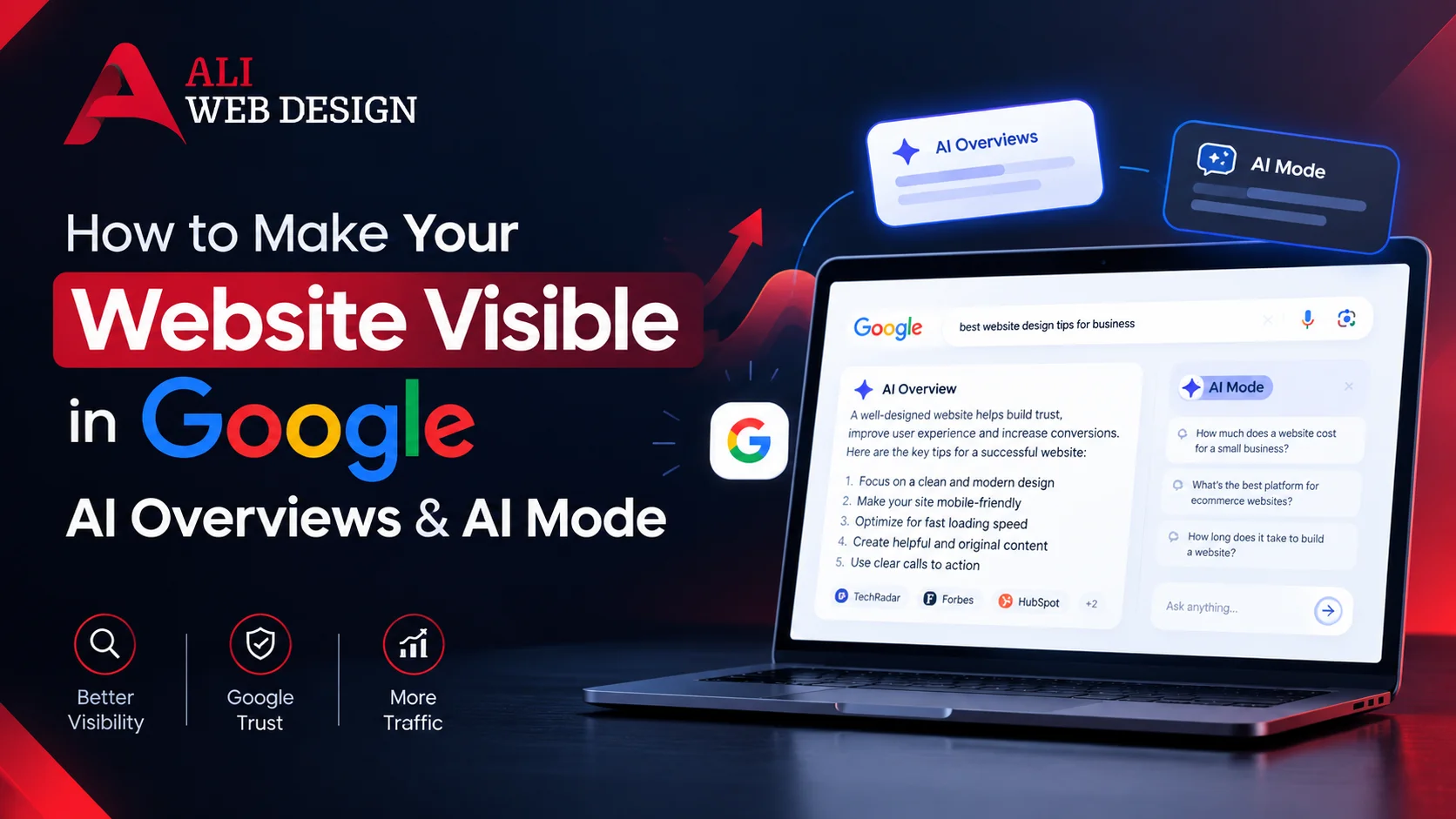
Google Search is changing, but one important thing has not changed: useful websites still need to earn Google’s trust. The difference is that people are increasingly asking Google questions that require a synthesized answer instead of simply typing a few keywords and scanning ten blue links. Google AI Overviews and AI Mode are designed around this behavior. Instead of only returning a ranked list of pages, Google’s generative experiences can combine information from multiple sources, explain a topic, compare options, answer follow-up questions, and provide links to supporting websites. That creates a new visibility opportunity for publishers, businesses, ecommerce stores, local companies, and service providers. The mistake is thinking that there is a secret “AI SEO trick” that guarantees inclusion. Google’s own documentation says the opposite: the existing fundamentals of SEO remain relevant because these generative experiences are rooted in Google’s core Search ranking and quality systems. So the goal is not to write content for a robot. The goal is to create a website that Google can crawl, understand, trust, and confidently use as a useful source when answering a person’s question.
What Google AI Overviews and AI Mode Actually Do
AI Overviews and AI Mode are related, but they serve somewhat different search experiences. AI Overviews can appear within ordinary Google Search when Google’s systems determine that an AI-generated explanation adds value to the query. They are particularly useful when someone needs a quick understanding of a complicated topic and then wants to explore supporting sources. AI Mode, on the other hand, is designed for deeper conversations and more complex exploration, allowing users to ask nuanced questions, compare alternatives, refine their searches, and continue with follow-up questions. Google explains that these systems can use a technique called “query fan-out,” where related searches may be performed across different subtopics and data sources before the response is assembled. That matters for website owners because visibility is no longer simply about matching one exact keyword. A page may become useful because it answers one part of a broader question, explains a specific concept, provides evidence for a claim, or supplies information that fits one of the subtopics Google is investigating. In practical terms, your website should be built like a reliable reference library rather than a collection of pages written around isolated keywords.
How AI Overviews Differ From Traditional Search
Traditional Google Search generally asks a straightforward question: which pages are relevant to this query, and how should they be ordered? AI search introduces another layer. Google can retrieve information from relevant pages and use those sources to construct a response containing explanations and links. This means a website can potentially gain visibility even when the user does not begin by searching the exact phrase used on your page. Imagine someone searches for “how much does it cost to build an ecommerce website in India?” A traditional search might return pages targeting that exact phrase. An AI-generated experience could break the question into related concepts such as ecommerce development cost, hosting, payment gateway fees, design requirements, maintenance, and platform considerations. A page that thoroughly explains several of those concepts may become useful to the response even if its primary keyword is different. Google’s current guidance therefore emphasizes the same fundamentals that have always mattered: useful content, crawlability, internal linking, strong page experience, textual information, relevant media, and accurate structured data. AI visibility should be viewed as an extension of good Search optimization, not as an entirely separate discipline.
Why AI Mode Changes the Search Journey
AI Mode makes search intent more conversational and exploratory. A user may begin with a broad question, receive an answer, and then immediately ask another question based on that answer. Instead of five separate Google searches, the person may conduct one extended conversation. This creates an opportunity for websites that explain subjects deeply enough to answer different stages of that journey. For example, a person planning a website might first ask about website development costs, then ask which platform is appropriate, then ask what features are necessary, and finally ask how long development usually takes. A website that has genuinely useful pages covering those connected subjects can become relevant at multiple points. The important word here is “genuinely.” Creating dozens of thin pages simply because you can imagine dozens of conversational questions is not the strategy Google recommends. Google’s current generative-AI guidance specifically warns against creating large amounts of content primarily to manipulate Search or AI responses. Instead, understand your audience, identify the questions they genuinely have, and build useful resources that solve those problems in depth.
The Real SEO Foundation Behind AI Visibility
Before worrying about AI visibility, make sure your website can actually participate in Google Search. This sounds obvious, but many websites have technical barriers that prevent important pages from being discovered, crawled, indexed, or displayed properly. Google states that to be eligible as a supporting link in AI Overviews or AI Mode, a page needs to be indexed and eligible to appear in Google Search with a snippet. There are no additional technical requirements specifically for AI features. That makes technical SEO extremely important. Check whether important pages are blocked by robots.txt, accidentally marked noindex, hidden behind login requirements, or dependent on functionality Google cannot properly access. Use Google Search Console’s URL Inspection tool to see how Google receives and processes important URLs. Make sure your XML sitemap contains the canonical pages you actually want indexed, and keep your site’s URL structure logical. If a page is excellent but Google cannot access or index it, its content quality cannot compensate for the technical problem. AI search starts with the same doorway as traditional Search: Google must be able to find, crawl, understand, and index your content.
Make Your Website Crawlable and Indexable
Think of crawling as giving Google permission to walk through your website’s library. If important doors are locked, the crawler cannot inspect the books behind them. Start by reviewing your robots.txt file and ensuring it does not accidentally block important resources or directories. Then check important pages for unintended noindex directives. Remember that robots.txt and noindex serve different purposes: robots.txt controls crawling access, while noindex tells Google not to include an accessible page in its index. Google specifically warns that blocking a page with robots.txt can prevent Googlebot from seeing a noindex instruction. After that, inspect your canonical tags, redirects, sitemap, status codes, and internal links. A clean technical foundation also matters for JavaScript-heavy websites. Google can process JavaScript, but JavaScript SEO can become more complicated when important content or links depend on client-side behavior. If your website uses a framework, dynamic rendering, heavy animations, or interactive components, make sure the actual important text is accessible to Google and users. A visually impressive website should never become a beautifully designed locked room.
Build Clear Internal Links and Site Architecture
Internal linking is one of the most underrated ways to make a website easier to understand. Google uses links to discover pages and understand relationships between pages, while descriptive anchor text gives users and search engines context about the destination. Instead of building isolated blog posts, create topic clusters where related pages naturally connect. Suppose you operate a web development agency. You might have a central service page for ecommerce development, supported by articles about ecommerce features, payment gateways, website maintenance, ecommerce SEO, conversion optimization, product page design, and development costs. Those pages should link naturally to each other when the connection helps the reader. Your navigation should also make sense without relying entirely on JavaScript interactions. Google recommends crawlable links, generally using standard anchor elements with actual href destinations. Clear architecture creates a logical map of your expertise. When Google encounters a page, it should be able to understand not only what that page discusses but also how the page relates to the rest of your website. That relationship becomes increasingly valuable as search systems try to understand topics rather than merely matching isolated words.
Create Content That AI Systems Can Understand
If technical SEO is the foundation, content is the substance. Google’s current generative-AI guidance repeatedly emphasizes valuable, unique, non-commodity content. That phrase matters because the internet is already full of pages saying essentially the same thing. If your article simply rearranges information that thousands of other websites already provide, it gives Google little reason to treat your page as a particularly useful source. Strong AI-search content should bring something meaningful to the table: first-hand experience, original examples, clear explanations, unique research, practical data, expert commentary, useful comparisons, demonstrations, or a perspective based on genuine knowledge. This does not mean every page needs proprietary research. A service company can create valuable content by explaining how it approaches projects, showing real examples, discussing common mistakes, documenting implementation decisions, or answering questions customers repeatedly ask. The strongest approach is to ask a simple question before publishing: Would this page still be useful if Google sent us zero traffic? If the answer is yes because real visitors would learn something, solve a problem, or make a better decision, you are much closer to the people-first approach Google recommends.
Answer Questions Clearly and Completely
AI systems need understandable information, and users do too. One effective approach is to structure important pages around the questions a real customer would naturally ask. Start with the direct answer instead of hiding it behind several paragraphs of introduction. Then explain the reasoning, exceptions, examples, costs, limitations, implementation details, or alternatives. This does not mean every paragraph needs to sound like a FAQ. Natural editorial writing can still be comprehensive. For example, instead of writing a generic article called “Website Development,” create a resource that clearly explains what website development includes, how different website types differ, what affects cost, what the client needs to provide, how development works, how maintenance works, and what questions should be asked before hiring a developer. Use headings that accurately describe the sections. Include important information in actual HTML text rather than putting essential explanations inside images or inaccessible interface elements. Google specifically recommends ensuring important content is available in textual form and supporting that text with high-quality images and videos when appropriate. The objective is simple: make the page easy for both a person and a search system to understand.
Demonstrate First-Hand Experience and Expertise
A website becomes more convincing when it demonstrates that its author actually understands the subject. If you sell a service, explain how you deliver it. If you review products, explain how you evaluated them. If you publish professional advice, use examples from real work where appropriate. Google recommends people-first content that demonstrates first-hand expertise and depth of knowledge, rather than pages created primarily to attract search traffic. This is especially important in competitive subjects where dozens of websites can produce generic AI-written summaries. Add author information where it helps establish who created the content. Explain relevant experience, methodology, sources, and limitations when appropriate. For business websites, case studies can be particularly valuable because they combine expertise with evidence. Instead of saying “we provide high-quality websites,” describe a real project, the original challenge, what was implemented, what changed, and what lessons were learned. The same principle applies to blog content. A generic explanation of website speed is easy to reproduce; an article explaining how you diagnosed a slow WordPress website, what caused the problem, what you changed, and what the measurements showed is much harder to replace. Authentic experience gives content substance.
Optimize Pages for Conversational Search
Search behavior is becoming more conversational, but that does not mean you should fill your content with awkward phrases such as “best website developer near me for affordable website development.” People do not naturally communicate that way, and Google does not require it. Google’s language systems can understand relationships between concepts and queries even when the exact words do not appear on a page. Your job is to write naturally while making the subject unmistakably clear. Use the primary topic in appropriate locations such as the title, main heading, introductory copy, relevant subheadings, and internal links, but do not force it repeatedly. Then expand naturally into related concepts that a genuine reader would expect. If you are writing about ecommerce development, readers may also care about payment gateways, product management, checkout, shipping, inventory, customer accounts, analytics, security, and maintenance. Cover those concepts because they belong to the subject, not because you are trying to create an artificial keyword cloud. Good conversational optimization is less about predicting Google’s exact wording and more about understanding the real-world problem behind the query.
Cover Related Questions and Search Intent
A single keyword rarely represents the entire information need. Consider the difference between “website cost” and “I run a small business and need a website; what will it cost, what features do I actually need, and what should I budget for maintenance?” The second query reveals a much larger intent. AI Mode is particularly suited to complex exploration, so pages that address the surrounding context can become more useful than pages narrowly optimized for one phrase. Build content around user problems rather than keyword lists. Ask what someone wants to know before the query, what they will probably ask next, what objections they may have, and what information they need to act confidently. Then organize the page so those questions are answered naturally. You can use FAQs, comparison sections, examples, definitions, step-by-step explanations, and supporting resources when each genuinely adds value. Avoid producing separate thin articles for every tiny variation. Google’s current guidance specifically cautions against generating content for every possible search variation merely to manipulate rankings or generative AI responses. One strong resource that covers an entire meaningful topic is often more useful than twenty shallow pages.
Use Natural Language Without Keyword Stuffing
Keyword stuffing belongs to an older version of SEO that modern search systems are increasingly good at ignoring or treating as a quality problem. A page does not become more relevant because the same phrase appears 70 times. In fact, excessive repetition can make the page uncomfortable to read and can signal that the content was written for search engines rather than people. Instead, use a natural vocabulary around the topic. If the page is about “WordPress website development,” naturally discuss themes, plugins, performance, security, content management, hosting, responsive design, maintenance, and customization where those concepts genuinely apply. Use synonyms where they sound natural, but do not obsess over semantic keyword variations. Google’s own SEO guidance says its language matching systems can understand how pages relate to queries without requiring every possible variation to be explicitly included. The better question is not “How many times did I use my keyword?” but “Could a first-time visitor understand exactly what this page is about within seconds?” Clear titles, useful headings, descriptive links, concise explanations, and complete coverage create a much stronger foundation for both traditional and AI-powered Search.
Strengthen Your Website’s Trust and Authority
Trust is not a single metric that you can switch on with a plugin. It is built from many signals and, more importantly, from the overall quality and usefulness of the website. A trustworthy business website should clearly explain who operates it, what it offers, how people can contact it, and what evidence supports its claims. Depending on the type of site, useful trust elements can include author information, company details, service descriptions, policies, references, case studies, customer experiences, professional credentials, original research, and transparent explanations. This does not mean adding fake testimonials or manufactured authority signals. In fact, misleading claims can damage trust rather than strengthen it. Think of your website as a professional storefront. Would a visitor feel comfortable relying on the information if they knew nothing about your company beforehand? Would they be able to verify important claims? Would they understand who created the information and why that person is qualified to discuss it? Google’s people-first guidance emphasizes satisfying the visitor rather than producing content primarily for rankings. That principle becomes particularly important when AI systems are deciding which pages provide useful supporting information.
Build Topical Authority With Useful Content
Topical authority is best understood as depth and consistency around a meaningful subject, not as publishing hundreds of articles. A website about digital marketing might publish excellent resources covering technical SEO, local SEO, content strategy, analytics, conversion optimization, and search visibility. A website about home renovation might cover planning, materials, costs, permits, design, maintenance, and project management. The individual pages should connect logically rather than feeling like unrelated attempts to capture traffic. Over time, this creates a useful information ecosystem. When someone lands on one page, they should be able to discover related resources that answer the next question naturally. This also creates opportunities for internal links and clearer site architecture. Avoid chasing every trending subject simply because it has search volume. Google’s helpful-content guidance specifically warns against producing content across many topics simply because you hope something will perform. Choose subjects that genuinely fit your site’s purpose and audience. Then go deeper than a generic summary by adding practical explanations, original examples, evidence, and experience. Authority is much easier to demonstrate when the website has a clear reason for existing.
Earn Relevant Mentions and Links
Links remain important because they help Google discover pages and understand relationships between websites and topics. But the objective should not be collecting hundreds of random backlinks. A small business with ten genuinely relevant mentions may have a more meaningful web presence than a site with hundreds of low-quality links from unrelated directories. Create things that people naturally want to reference: original research, useful tools, detailed guides, industry resources, case studies, data, unique visual resources, or genuinely helpful local information. Then make those resources easy to discover and share. Partnerships, professional associations, community participation, interviews, legitimate publications, and industry contributions can also lead to relevant mentions. Avoid buying links or participating in artificial link schemes simply because someone promises an “AI SEO backlink package.” Google’s Search guidance explicitly warns against unnatural linking practices. The same principle applies to AI visibility: trying to manufacture signals is less sustainable than becoming a source that other people genuinely want to reference. Think of links as recommendations in the wider web ecosystem. You cannot force every recommendation to be meaningful, but you can give people something worth recommending.
Use Structured Data the Right Way
Structured data can help Google understand the meaning and organization of your content, but it is frequently misunderstood in discussions about AI SEO. There is no special “AI Overview schema” that you need to install. Google’s current documentation explicitly states that there is no special schema.org structured data required for AI Overviews or AI Mode. Instead, use structured data when it accurately represents the type of content on your page and when Google supports or benefits from that understanding. Depending on your website, this might include Organization, LocalBusiness, Product, Article, Breadcrumb, ProfilePage, Event, Recipe, or another appropriate type. The key is accuracy. Structured data should match the visible content on the page and should not be used to tell Google something that users cannot actually see. Schema is best viewed as additional context, not a magic ranking switch. If your underlying content is weak, structured data will not transform it into an authoritative source. If your content is strong, accurate structured data can make the page’s meaning easier for search systems to interpret and can make the website eligible for applicable Search features.
Keep Schema Consistent With Visible Content
The safest structured-data strategy is surprisingly simple: mark up what is genuinely present on the page. If your business has an address, opening hours, and other legitimate local information, appropriate LocalBusiness markup can help Google understand those details. If a page contains a real article, Article markup may be appropriate. If you publish an actual product page, Product structured data can provide relevant product information. But do not invent ratings, prices, authors, reviews, or other properties simply because you believe they might improve visibility. Google provides validation tools and documentation for supported structured-data types, and it recommends checking implementations with tools such as the Rich Results Test and URL Inspection where appropriate. Also remember that valid structured data does not guarantee that Google will display a rich result. Structured data is an aid to understanding and eligibility, not a promise of a particular search appearance. For AI search, the same philosophy applies. The strongest combination remains visible, useful content plus technically correct markup that accurately describes what users can see.
Why There Is No Special AI Overview Schema
The idea of an “AI SEO schema” sounds attractive because it suggests there is a technical shortcut. According to Google’s current documentation, there isn’t one. Google says that no special schema.org structured data or new machine-readable AI files are required to appear in AI Overviews or AI Mode. You therefore do not need to add an imaginary “AIOverview” schema, create a special AI sitemap, or publish an AI-specific version of every article. What you need is much more fundamental: crawlable pages, indexable content, useful information, strong site structure, good page experience, accurate structured data where applicable, and compliance with Search policies. This is actually good news because it means your investment in solid SEO is not becoming obsolete every time Google changes its interface. If you already have a well-structured website, you are building on the same foundation used by Google’s generative experiences. The terminology around AEO, GEO, LLM SEO, and AI SEO may change rapidly, but Google’s underlying recommendation is considerably more stable: make useful information accessible and understandable, and focus on satisfying people rather than manipulating search systems.
Optimize Images, Video, and Local Information
Text is extremely important, but modern search is not text-only. Google recommends supporting textual content with high-quality, relevant images and videos when they are useful. For a service business, this might mean original project photographs, screenshots, demonstrations, diagrams, videos explaining processes, or before-and-after examples. For an ecommerce website, it means clear product images with appropriate surrounding information. For a local business, useful visual content can help communicate the actual location, services, products, facilities, and customer experience. The same basic SEO principles apply: use descriptive filenames where practical, relevant alt text for accessibility and context, appropriate image dimensions, and fast-loading formats. Do not hide critical information exclusively inside images. If an important service detail appears only in an infographic, consider providing the same information as HTML text. Video should also support the page rather than simply decorate it. Think of multimedia as evidence and explanation. A photograph can demonstrate a project, a video can show a process, and a diagram can simplify a complicated concept. These assets make a page richer for humans while also giving search systems additional context when implemented correctly.
Make Visual Content Search-Friendly
A common mistake is uploading beautiful media without giving Google enough surrounding context to understand why it matters. Search engines do not experience an image exactly as a human visitor does, so the page should provide useful textual signals around important visual assets. If you publish a photograph of a completed kitchen renovation, the surrounding copy can explain the project, materials, location, design challenge, and result. If you publish a tutorial video, the page can summarize what the viewer will learn and provide supporting text. Image filenames, alt text, captions, headings, and nearby content should all be descriptive when appropriate rather than stuffed with keywords. Accessibility should be part of this process too. Good alt text helps users who rely on screen readers and can also give search systems useful context. Do not describe every decorative element just to create more text. Instead, ask whether the image communicates information that a visitor needs. If it does, explain it clearly. If it is purely decorative, do not force an SEO description where none is needed. Google’s current AI-search guidance specifically recommends continuing existing image and video SEO best practices rather than inventing an entirely new optimization system.
Strengthen Local and Business Signals
For local businesses, AI search can make location and business information particularly important because users often ask questions that combine service, location, availability, reputation, and practical details. Make sure your website clearly identifies the business name, service area, physical address where applicable, phone number, hours, services, and other factual information. Keep your Google Business Profile information accurate and consistent with your website. Google specifically includes keeping Business Profile information up to date among the existing best practices relevant to AI features. LocalBusiness structured data can also help Google understand business details where appropriate, although markup does not guarantee a particular result. Build useful location pages only when they represent genuine services or locations rather than creating hundreds of nearly identical city pages. A real business serving Kolkata, for example, should explain its actual service area, projects, customer needs, and local context instead of creating thin pages for every nearby locality simply to capture keywords. Local relevance is strongest when it reflects reality. If your business genuinely operates in multiple places, give users useful information about each one. If it doesn’t, don’t manufacture locations for SEO.
Measure AI Search Visibility
One of the biggest changes for SEO professionals in 2026 is that Google Search Console now provides dedicated reporting for visibility in generative AI features. Google announced Search Generative AI performance reports in June 2026, covering impressions from generative AI experiences such as AI Overviews and AI Mode, and Google stated that the rollout reached all websites worldwide by August 31, 2026. This gives website owners a more direct way to evaluate how their content performs within Google’s evolving search experiences. The important point is to avoid treating AI visibility as a vanity metric. Look at which pages receive exposure, which queries or topics are associated with that exposure, whether those visits produce meaningful engagement, and whether the pages satisfy the intent that brought visitors there. Traditional Search Console data remains valuable too, particularly impressions, clicks, queries, indexing status, and page-level performance. Combine that information with analytics and actual business outcomes. A page appearing in an AI response may be valuable even if its click-through rate differs from a traditional result because the search journey itself is changing. The goal should be sustainable visibility and useful traffic, not simply collecting screenshots of your brand appearing in an AI answer.
Use Search Console to Monitor Generative AI Performance
A practical measurement process begins with establishing a baseline. Identify your most important commercial pages, informational resources, local pages, and content clusters. Monitor how they perform in ordinary Search and in the available generative-AI reporting. When a page gains visibility, investigate why it may be useful: Does it answer a specific question clearly? Does it contain original information? Does it have strong internal links? Is the page well structured? Does it demonstrate expertise? When a page loses visibility, avoid immediately rewriting everything. First inspect indexing, technical changes, content changes, search intent, competing resources, and broader Search changes. Google repeatedly emphasizes that meeting requirements does not guarantee crawling, indexing, or serving, so SEO performance should be treated as an ongoing process rather than a one-time certification. Also monitor conversions, not just impressions. A smaller amount of highly relevant visibility can be more meaningful to a business than enormous exposure for unrelated queries. AI search measurement should ultimately connect visibility to outcomes: qualified leads, enquiries, purchases, subscriptions, bookings, downloads, or whatever success means for your website.
Common AI SEO Mistakes to Avoid
The biggest mistake is believing that AI search requires a completely separate bag of tricks. It doesn’t. Another mistake is publishing enormous quantities of AI-generated articles without adding meaningful value. Google’s spam policies explicitly address scaled content abuse, including large amounts of unoriginal content created primarily to manipulate Search rankings or generative AI responses. Using AI as an assistant for research, brainstorming, editing, outlining, or production can be perfectly compatible with quality content, but the finished material still needs to satisfy users and Search policies. Other common mistakes include blocking important pages from Google, accidentally using noindex, relying on image-only content, creating poor internal linking, stuffing keywords, generating doorway-style location pages, adding inaccurate structured data, copying competitors, and obsessing over hypothetical AI-specific ranking factors. Another dangerous habit is creating an article for every imaginable question instead of building a few excellent resources around genuine customer needs. Google specifically warns against producing pages primarily for search engines and against creating content across many topics simply in the hope that something ranks. The better approach is almost boringly practical: solve real problems, explain things clearly, make the website technically accessible, and continually improve based on evidence.
A Practical 90-Day AI Search Strategy
If you want to improve your website’s visibility in AI Overviews and AI Mode, you do not need to rebuild everything overnight. Start the first 30 days with a technical and content audit. Check indexing, robots.txt, noindex directives, canonical URLs, sitemaps, broken links, internal linking, mobile usability, page speed, important textual content, structured data, and Google Search Console coverage. At the same time, identify your most important customer questions and determine whether your current pages answer them properly. During days 31 to 60, strengthen your core content. Improve important service and product pages, publish genuinely useful supporting resources, add original examples, improve internal links, update outdated information, and strengthen author or business information where relevant. During days 61 to 90, focus on authority and measurement. Promote genuinely useful resources, earn relevant mentions, improve local information if applicable, review Search Console performance, and identify pages receiving generative-AI visibility. Then iterate. Do not judge the strategy after a few days. Google needs to crawl and process changes, and search visibility naturally evolves. The objective is to create a website that remains useful regardless of whether a visitor arrives through a classic blue link, an AI Overview, AI Mode, an image result, a local result, or another Search interface.
Conclusion
Making your website visible in Google AI Overviews and AI Mode is less mysterious than the SEO industry sometimes makes it sound. Google’s current guidance points back to the fundamentals: your important pages need to be crawlable and indexable, your content needs to be helpful and reliable, your site architecture should make information easy to discover, your important information should exist in accessible text, your structured data should be accurate, your visual content should be useful, and your overall website should provide a good experience. There is no secret AI Overview schema, no guaranteed AI ranking formula, and no requirement to create a separate version of your website exclusively for Google’s generative systems. The more sustainable strategy is to become a genuinely useful source. Answer real questions, demonstrate real expertise, publish information that adds something new, connect related resources logically, and make your claims easy to understand and verify. AI search changes the interface between people and information, but it does not eliminate the fundamental reason search engines exist: helping people find useful information. If your website consistently provides that value, you are building on the same foundation Google says its AI experiences rely upon.
Frequently Asked Questions
No. Google explicitly states that there is no special schema.org structured data required for AI Overviews or AI Mode. Existing structured-data best practices still matter when they accurately describe visible content on your pages. The more important foundation is that your page is crawlable, indexed, eligible for a Search snippet, useful to visitors, and compliant with Google’s Search policies. Structured data can help Google understand supported content types and may make pages eligible for certain Search features, but it does not guarantee inclusion in an AI-generated answer. Treat schema as a way of communicating accurate page information, not as an AI ranking shortcut.
Yes. Google says that its generative AI features are rooted in its core Search ranking and quality systems, meaning established SEO practices remain relevant. Technical accessibility, crawlability, internal links, helpful content, page experience, structured data, images, video, and accurate business information continue to matter. You should therefore avoid thinking of SEO and AI SEO as two completely separate disciplines. Instead, improve your existing Search foundation while creating content that thoroughly answers real user needs.
No. Quantity alone is not a reliable strategy, and creating large volumes of unoriginal content primarily to manipulate Search or AI responses can violate Google’s scaled content abuse policies. AI tools can assist with content creation, but the finished material should provide genuine value and meet Google’s people-first standards. A smaller collection of comprehensive, original, experience-driven resources can be more useful than hundreds of thin articles targeting slightly different keyword variations. Focus on the questions your actual audience needs answered.
Use Google Search Console and monitor the generative-AI reporting available for your property. Google announced dedicated reporting for visibility in AI Overviews and AI Mode, and the rollout reached websites worldwide by August 31, 2026. You should also continue monitoring ordinary Search performance, indexing, queries, clicks, impressions, and page-level data. Looking at both traditional and generative-AI performance gives you a much more complete picture of how your website is being discovered.
Start by creating useful, original, people-first content on a technically accessible website. Make your important pages crawlable and indexable, explain topics clearly, demonstrate genuine expertise, use natural language, connect related pages through internal links, and keep important information available as text. Then improve the site based on real Search Console data rather than chasing every new AI SEO trend. Google’s own guidance consistently brings the strategy back to the same principle: create content that users find helpful and satisfying while maintaining a technically sound website.
Founded in 2022 by Md Intezam Ali, Ali Web Design has successfully delivered 200+ WordPress projects across Kolkata and beyond. Our expertise in web development, e-commerce solutions, LMS platforms, and website maintenance makes us the ideal partner for your WordPress 7 AI content implementation.
For any WordPress Web Development projects, Contact Us